
Course Overview
Supporting the adoption of container technology through the development of cloud-native applications.
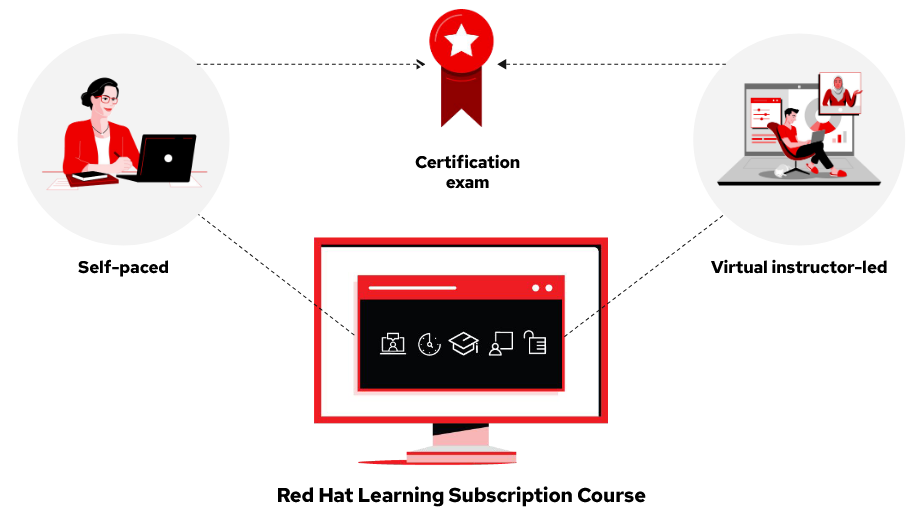
The Container Adoption Boot Camp for Developers (DO720) immerses you in intensive, hands-on development of cloud-native applications deployed on Red Hat's implementation of Kubernetes, Red Hat® OpenShift® Container Platform. As part of enrollment, you will receive one year of Red Hat Learning Subscription Standard, which gives you unlimited access to all of our courses online, plus up to 5 certification exams and 2 retakes. This boot camp is for those seeking to make a quantum leap in their journey toward digital transformation. Making this shift involves developing software in tight iterations so that business value can be realized sooner. In order to accomplish this goal, this offering can facilitate the adoption of cloud-native applications, including microservices.
This collection of courses is based on Red Hat OpenShift Container Platform 4.12 and Red Hat Build of Quarkus 2.13.
Who should attend
Developers interested in adopting container technology and developing microservices
Prerequisites
- Become a Red Hat Certified System Administrator (RHCSA), or demonstrate equivalent experience
- Red Hat Application Development I: Programming in Java EE (AD183) (or experience with Java EE development)
Course Objectives
Impact on the organization
This boot camp is intended to provide developers who have basic to intermediate knowledge of containers with the foundational and advanced skills needed to develop, deploy, and troubleshoot microservices applications with Red Hat OpenShift Container Platform. Red Hat OpenShift Container Platform enables rapid application development and deployment, as well as portability of an application across environments. The platform also offers simplified application scaling, administration, and maintenance of cloud-native applications.
Impact on the individual
As a result of attending this course, you should be able to install, configure, and manage a Red Hat OpenShift Container Platform cluster and deploy applications on it.
You should be able to demonstrate these skills:
- Design container images to containerize applications.
- Build and manage custom container images.
- Persisting Data in container based applications.
- Deploy applications to OpenShift Container Platform.
- Develop microservices using Quarkus.
- Implement health checks in microservices to improve system reliability.
- Implement unit and integration tests for Quarkus microservices.
- Implement fault tolerant Quarkus microservices
- Secure Quarkus microservices using JWT and OAuth
Detailed Course Outline
Introduction and Overview of Containers
Describe how containers facilitate application development
Podman Basics
Manage and run containers with Podman
Container Images
Navigate container registries to find and manage container images
Custom Container Images
Build custom container images to containerize applications
Persisting Data
Run database containers with persistence
Troubleshooting Containers
Analyze container logs and configure a remote debugger
Multi-container Applications with Compose
Run multi-container applications with Podman Compose
Red Hat OpenShift Container Platform for Developers
Define the Red Hat OpenShift architecture, concepts and terminology, and set up the developer environment
Deploying Simple Applications
Deploy simple applications by using the Red Hat OpenShift web console and command-line tools
Building and Publishing Container Images
Build, deploy, and manage the lifecycle of container images by using a container registry
Managing Red Hat OpenShift Builds
Describe the Red Hat OpenShift build process and build container images
Managing Red Hat OpenShift Deployments
Describe the different Red Hat OpenShift deployment strategies and how to monitor the health of applications
Deploying Multi-container Applications
Deploy multi-container applications by using Red Hat OpenShift Templates, Helm Charts and Kustomize
Introducing the Red Hat Build of Quarkus
Describe the components and patterns of microservices-based application architectures and the features of the Red Hat Build of Quarkus
Developing Cloud-native Microservices with Quarkus
Implement microservices based applications by using the Red Hat Build of Quarkus runtime and associated developer tooling
Testing Quarkus Microservices
Implement unit and integration tests for microservices
Securing Quarkus Microservices
Secure microservice communications by applying origin validation, request authentication and authorization
Implementing Quarkus Microservices on the Red Hat OpenShift Container Platform
Develop and deploy cloud-native applications on the Red Hat OpenShift Container Platform
Implementing Fault Tolerance in Microservices
Implement fault tolerance in a microservice architecture
Monitoring Quarkus Microservices
Monitor the operation of a microservice by using metrics and distributed tracing
Course Content
- Introduction to containers, Kubernetes, and Red Hat OpenShift
- Deploy and manage applications on an OpenShift cluster
- Build and design containerized applications for OpenShift
- Create microservice-based applications with Quarkus
- Deploy Quarkus and Node.js based microservices to an OpenShift cluster
- Learn how to test, secure, and monitor Quarkus microservices
- Make Quarkus microservices fault tolerant