
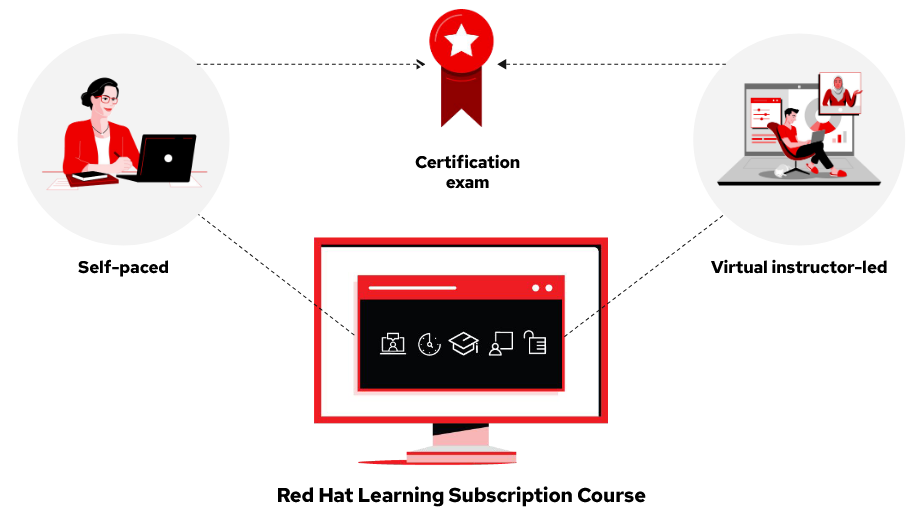
Course Overview
Red Hat OpenShift Administration I: Operating a Production Cluster (DO180) prepares OpenShift cluster administrators to manage Kubernetes workloads and to collaborate with developers, DevOps engineers, system administrators, and SREs to ensure the availability of application workloads. This course focuses on managing typical end-user applications that are often accessible from a web or mobile UI and that represent most cloud-native and containerized workloads. Managing applications also includes deploying and updating their dependencies, such as databases, messaging, and authentication systems.
The skills that you learn in this course apply to all versions of OpenShift, including Red Hat OpenShift on AWS (ROSA), Azure Red Hat OpenShift (ARO), and OpenShift Container Platform.
This course is based on Red Hat OpenShift 4.18.
Who should attend
- Primary: Platform Engineers, System Administrators, Cloud Administrators, and other infrastructure-related IT roles who are responsible for tier-1 support of infrastructure for applications.who are interested in managing OpenShift clusters and containerized applications.
- Secondary: Enterprise Architects, Site Reliability Engineers, DevOps Engineers, and other application-related IT roles who are responsible for designing infrastructure for applications.
- Developers and Site Reliability Engineers that are new to container technology should enroll in Red Hat OpenShift Development I: Introduction to Containers with Podman (DO188).
Certifications
This course is part of the following Certifications:
Prerequisites
- Take our free assessment to gauge whether this offering is the best fit for your skills.
- Prerequisite: Containers, Kubernetes and Red Hat OpenShift Technical Overview (DO080) or equivalent knowledge of Linux containers.
- Prerequisite: Getting Started with Linux Fundamentals (RH104) or equivalent proficiency in using a command line interface, ideally operating a Bash shell, is required.
Course Objectives
Impact on the organization
This course is intended to develop the skills needed to manage Red Hat OpenShift clusters and support containerized applications that are highly available, resilient, and scalable. Red Hat OpenShift is an enterprise-hardened application platform based on Kubernetes that provides a common set of APIs and abstractions that enable application portability across cloud providers and traditional data centers. Red Hat OpenShift adds consistency and portability of operational processes across these environments and can also be deployed as a managed service. An external SRE team shares the responsibility of managing Red Hat OpenShift clusters with a customer’s IT operations team when using a managed OpenShift offering such as Red Hat OpenShift on AWS (ROSA) or Azure Red Hat OpenShift.
Impact on the individual
As a result of attending this course, students will understand the architecture of Red Hat OpenShift clusters and of Kubernetes applications, and will be able to deploy, manage, and troubleshoot applications on OpenShift. Students will also be able to identify and escalate application and infrastructure issues to development teams, operation teams, and IT vendors.
Detailed Course Outline
Introduction to Kubernetes and OpenShift
Identify the main Kubernetes cluster services and OpenShift platform services, and monitor them from the web console.
Kubernetes and OpenShift Command-Line Interfaces and APIs
Access an OpenShift cluster from the command line, and query its Kubernetes API resources to assess the health of a cluster.
Run Applications as Containers and Pods
Run and troubleshoot containerized applications as unmanaged Kubernetes pods.
Deploy Managed and Networked Applications on Kubernetes
Deploy applications and expose them to network access from inside and outside a Kubernetes cluster.
Manage Storage for Application Configuration and Data
Externalize application configurations in Kubernetes resources, and provision storage volumes for persistent data files.
Configure Applications for Reliability
Configure applications to work with Kubernetes for high availability and resilience.
Manage Application Updates
Manage reproducible application updates and rollbacks of code and configurations.
Follow On Courses
Course Content
- Managing OpenShift clusters from the command-line interface and from the web console
- Deploying applications on OpenShift from container images, templates, and Kubernetes manifests
- Troubleshooting network connectivity between applications inside and outside an OpenShift cluster
- Connecting Kubernetes workloads to storage for application data
- Configuring Kubernetes workloads for high availability and reliability
- Managing updates to container images, settings, and Kubernetes manifests of an application
 English
 German
 French
 Italian
 Dutch
Dutch